
Did you know that over 13% of students in the USA have some form of learning disability (LD) that effects their learning? That means 13 out of every 100 students is struggling with school.
Recently we have seen a rise in the number of children with LDs, but nobody knows if diagnosis has gotten better or more children are struggling. One thing we do know is those without an LD have a difficult time understanding what it’s like to struggle with learning. As a parenting coach, I often start by helping the parent see things from their child’s perspective, and this can be a life altering shift in how they parent their child.
That’s why I put together this collection of audio, video and graphic files which provide a simulation of how individuals with learning disabilities experience their learning environment. This is an opportunity for you to gain understand, empathy, and really comprehend the challenges these students face.
I have compiled simulations of the following learning disabilities:
- ADHD
- Auditory Processing Disorder
- Autism
- Dysgraphia
- Dyslexia
- Visual Processing Disorder
ADHD
11% of school-aged children are diagnosed with Attention Deficit Hyperactivity Disorder (ADHD). The cultural assumption is that kids with ADHD have a chemical imbalance in their brain that causes them to fall asleep and interferes with their ability to focus. The truth is there are many issues that can cause attention problems, and these issues often go unidentified.
This video simulation gives an idea of how the ADHD brain responds to input while walking down the street. The mind is bombarded with so much information, and the ADHD mind has difficulty sorting and prioritizing it. Not everybody with ADHD experiences it this way, but this demonstration is a great example of how difficult it is to focus on one thing when so many other things are happening at the same time.
Auditory Processing Disorder
Auditory Processing Disorder (APD) is another disability that is sometimes known as dyslexia of the ears. Some audiologists have suggested that it might be an auditory form of dyslexia. A person with APD will have a normal hearing test, but the brain misinterprets what is heard. As a result, the information that is heard gets scrambled, and the person will often misunderstand what is said to them.
APD can cause significant issues in social situations, the classroom or in noisy environments. Besides just understanding what is heard, it can cause a variety of symptoms, including inattention, fatigue when listening for lengths of time, difficulty following directions, poor social skills and sensitivity to noise.
Here is a simulation created by SoundSkills in New Zealand. It demonstrates what it may be like to have APD.
Autism
Autism manifests so uniquely in each person, it is difficult to generalize symptoms. Some say when you have met one person with autism, you have met one person with autism because symptoms are so unique. One aspect of autism that is generally universal is sensory overload. Many individuals with autism talk about the overwhelming nature of the world, and in some cases it can be so intense it is painful.
The following video provides a window into the sensory experience when input is too much. This is hard to watch and hear, so prepare yourself. Then next time you see a child melting down in a public place, you may consider it is a reaction to the sensory overload.
ABC’s 20/20 TV show created the following video about Carly Fleischmann, a young woman with non-verbal autism. The following fascinating video is from ABC’s 20/20 TV show. It shares insight into the world Carly Fleischmann, a woman with non-verbal autism. When she was 16 she learned to type, and for the first time in her life she was able to communicate her feelings. She talks about what it’s like to have autism, allowing us to peek into the world that before was unknown.
Dysgraphia
Some children struggle to learn how to write their letters, and sometimes this carries into difficulty gathering and articulating their thoughts in writing. This disability is known as Dysgraphia. Learning to write letters and words can be helped with occupational therapy, and learning how to write sentences and essays can be helped by a learning specialist. Often children who are gifted in math struggle with writing, and they may be diagnosed with dysgraphia.
Dysgraphia can affect all areas of learning, and often the child needs more time for exams or assignments that require writing. Specialized instruction and assistive technology solutions can help them learn to write better.
This simulation will help you experience what is going on in the brain of a child with dysgraphia when they are tasked with writing. The structure and rules for writing assignments can be so overwhelming, and the child cannot figure out a way to begin.
Dyslexia
Dyslexia was one of the first disability to be formally diagnosed and is probably the most well-known. It comes in several forms. The most well known form is when a person flips letters or mixes them up. This can happen when reading, or when writing. Keep in mind it is normal for a child to flip letters and numbers through the age of 6. After that they should settle on their proper direction.
Dyslexia shows up first as a problem with reading, but it can also cause writing difficulties, organizational problems, school refusal and attention challenges.
The following simulation demonstrates how some people experience dyslexia.
Notice how the text is always shifting, so it is difficult to know for sure what the word is supposed to be.
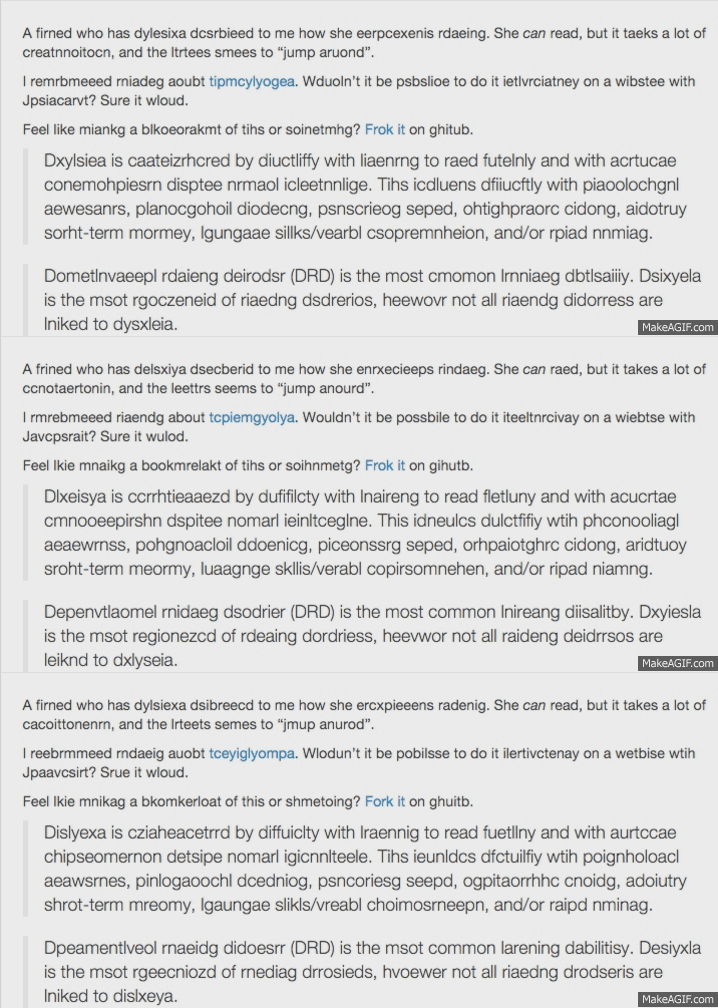
There are different forms of dyslexia, so not everybody with dyslexia experiences the letters moving and shifting. For some, the letter flipping occurs between similar letters, such as p and q or b and d.
View another Dyslexia Simulation by WebAIM to see what it might be like if the letters are always flipped and words do not present properly. https://webaim.org/simulations/dyslexia
Visual Processing Disorder
When a child’s eyes do not work as a team, the child may have a visual processing disorder (VPD). They can have 20/20 vision and pass their school vision test, but still have problems with their eyes when reading or doing other visual tasks. This type of learning disability can mimic other disabilities (like dyslexia), so it often goes undetected. When a student has VPD, it affects ALL schoolwork, and can cause many symptoms such as fatigue when reading, attention difficulties, fidgety behavior, and work refusal.
There are several forms of VPD. Some of the most common are:
- Eye tracking difficulty
- Convergence insufficiency
- Teaming issues
- Strabismus
- Visual discrimination
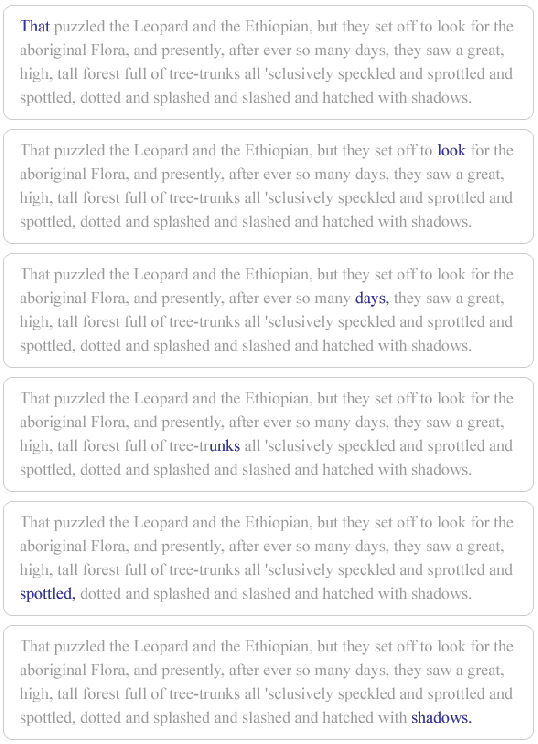
Below I created a simulation of how the eyes move when a child has eye-tracking difficulties, a form of VPD. Notice how the eyes jump all over the place instead of reading the lines straight across. This is why children with tracking issues lose their place while reading. Imagine how difficult reading comprehension would be if your eyes were moving like this whenever you read!
We should all try to understand the challenges a learning disability presents.
If you don’t have a learning disability, it can be hard to understand the tremendous effort that is required to learn with one. If your child has learning challenges in school, these demonstrations are well worth your time. Through developing understanding, you can develop your patience, and this can go a long way to supporting the success of your child.
ABOUT THE AUTHOR:
Bonnie Landau is a professional counselor and holistic therapist in Ventura County, California. Her specialities include therapy for autism, therapy for ADHD, and therapy for parenting who have kids with autism or ADHD or other neurodivergence. She changed careers from graphic designer to psychotherapist with the goal of helping struggling parents of kids with ADHD, autism, or other neurodivergence find strategies and solutions to help their children succeed.
Bonnie is also the author of Special Ed Mom Survival Guide: How to Prevail in the Special Education Process and Find Life-long Strategies for You and Your Child.

